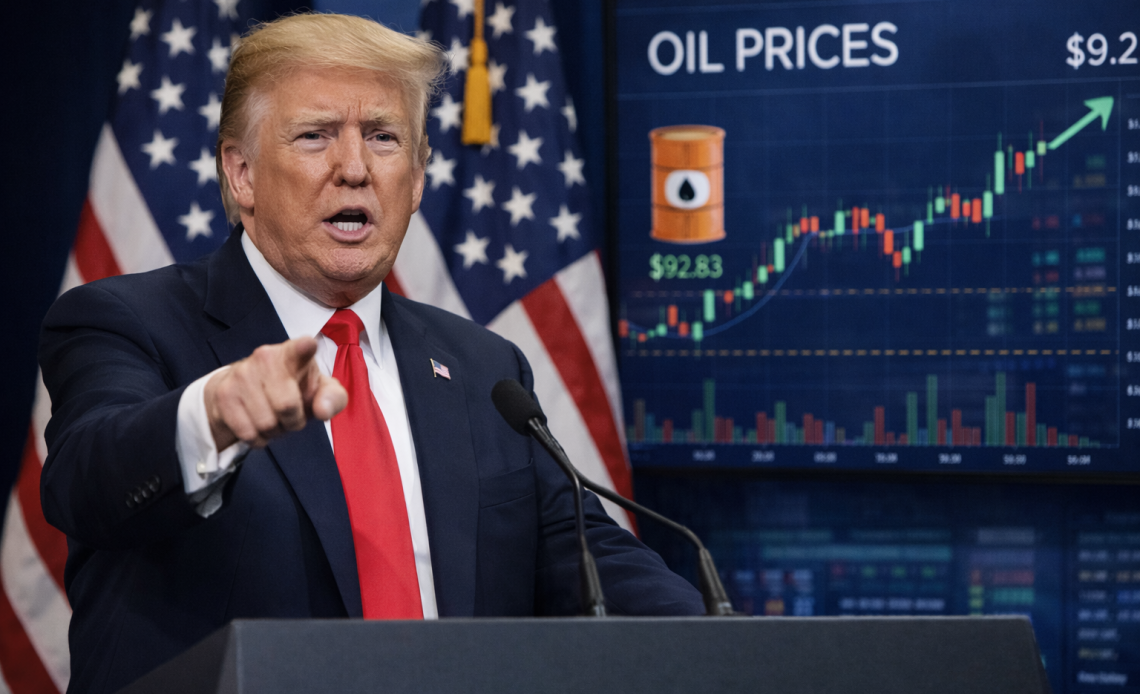
At 6:12 on a Tuesday morning, Trump posted that a whole civilisation would die that night.
By 8 p.m., he had announced a ceasefire.
By Wednesday’s open, the Nasdaq was up 3.5%, oil had shed 16%, South Korea’s Kospi had soared 6.9%, and emerging markets were posting their best single day since 2022.
If you are an investor trying to make rational, long-term financial decisions in this environment, you are not imagining the difficulty.
The rules genuinely have changed.
So how can ordinary investors actually make sound financial decisions based on a geopolitical situation that moves this fast, driven by a decision-maker who treats maximum uncertainty as a deliberate instrument of policy?
This is a trading environment, not an investing one
There is an important distinction that is getting lost in the noise. Investing, in its traditional form, assumes a baseline of policy predictability.
You build a thesis based on earnings, on sector growth, and on macro trends, and you hold a position long enough for fundamentals to play out.
But that framework has been severely disrupted. What we have now is an event-driven market where a single Truth Social post can move oil 5% before most people have had their coffee.
Positioning ahead of a presidential announcement has become more valuable than any earnings model.
Sophisticated institutional money recognised this early. The “TACO trade” is now a legitimate institutional strategy with a documented track record. Buy the dip on escalation, sell the relief rally.
It worked on tariffs with China, Canada, and Europe.
It worked on every Iranian deadline from March 21 onward.
It worked Tuesday night again.
Europe’s largest asset manager, Amundi, which oversees €2.38 trillion, stated that the firm is already positioned for a TACO.
The asymmetry that Wall Street is not talking about
Here is the inequality at the heart of this market that nobody is discussing enough.
Institutional money profits from the TACO pattern because they have the tools, the speed, and the risk tolerance to trade it.
Ordinary investors, meanwhile, pay $4.14 a gallon, watch grocery bills climb, and take “civilisation dies tonight” completely at face value, because for them the consequences are real whether the rhetoric is performative or not.
Wall Street and Main Street are experiencing the same presidency through entirely different financial lenses. One group is getting rich on the volatility. The other is absorbing it.
This is the tariff playbook applied to a war, and once you see the pattern, you cannot unsee it.
Maximum aggression, hard public deadline, escalating rhetoric, last-minute pivot framed as total victory, kick the can forward.
The critical difference is that when the tariff playbook fails, you get economic damage. When the war playbook fails, you get body counts.
So while the improvisational framework is identical, the downside is not.
What is the relief rally actually telling you?
Wednesday’s market surge was real, and the instinct to chase it is understandable.
But there are two things worth separating. First, the enormous pool of capital that had been sitting on the sidelines during this conflict did not just breathe a sigh of relief — it redeployed simultaneously into equities, credit, and commodities.
Second, oil is still up more than 40% since February 28.
Gas prices are still above $4 a gallon.
The inflation that was baked into supply chains, shipping contracts, and food prices during six weeks of war does not unwind overnight. Reopening the Strait stops the bleeding. It does not undo the wound.
Lloyd’s of London, the world’s primary maritime insurance hub, said clearly after the ceasefire:
“It is highly unlikely that trade into the Gulf will simply resume. The region remains at heightened risk with none of the underlying tensions resolved.”
"It is highly unlikely that trade into the Gulf will simply resume. The region remains at heightened risk with none of the underlying tensions resolved."
War risk premiums will not normalise until ships transit safely and repeatedly — and that takes weeks, not hours.
So what should a broad investor actually do?
The uncomfortable truth is that the TACO trade works until the one time it catastrophically does not.
Markets are writing naked options against a black swan they have convinced themselves cannot arrive.
Every time the pattern holds, the complacency deepens.
The danger is not that Trump always folds — it is that one day he does not, and nobody is positioned for it. Islamabad talks on Friday, IRGC compliance with the ceasefire, Lebanon’s unresolved status — any one of these could produce the incident that unravels this agreement within days.
The ceasefire is real enough to justify the relief rally, but not durable enough to justify repositioning your entire portfolio around it. Two weeks is not a time horizon.
The practical framework for this environment is to reduce exposure to instruments that are most sensitive to a single announcement, maintain more cash than you normally would, and accept that in a Truth Social market, the cost of staying sane is occasionally missing a move.
The investors who slept well through “civilisation dies tonight” and still captured most of Wednesday’s upside were not the ones who had bet everything on the outcome.
They were the ones who had sized their positions for a world where the news changes every six hours. Because right now, it does.
The post Why ordinary investors are struggling in Trump’s Truth Social market appeared first on Invezz