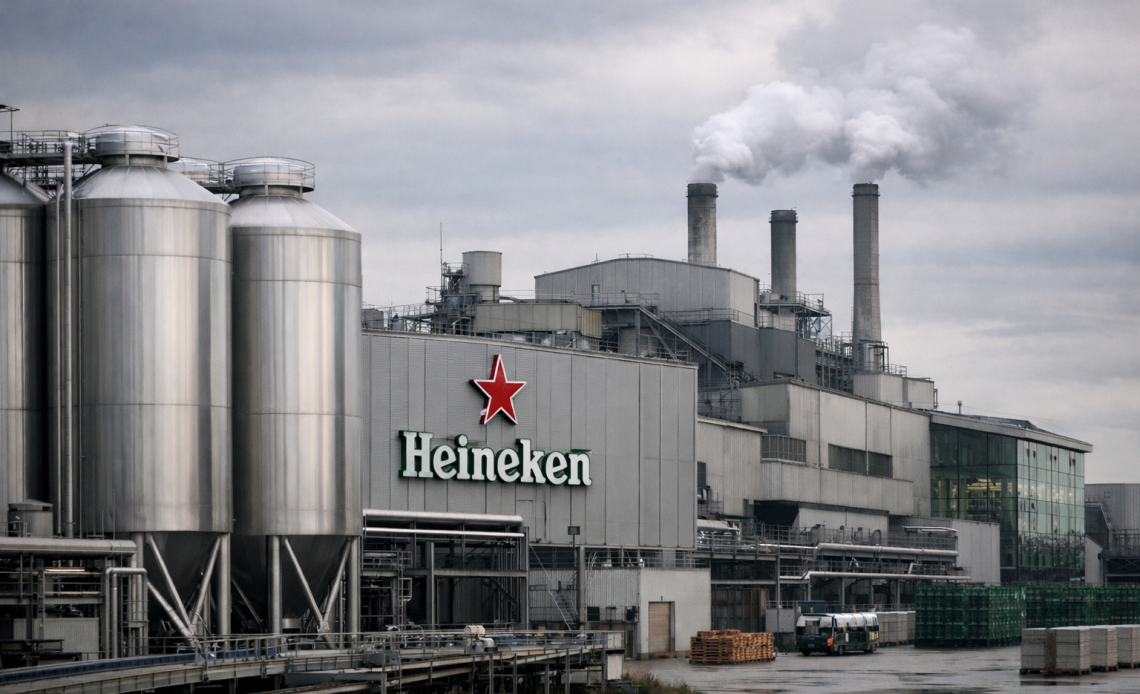
Heineken’s share price fell more than 4% on Monday after chief executive Dolf van den Brink said he would step down at the end of May, marking a leadership change at a difficult juncture for the world’s second-largest brewer.
Van den Brink, a company veteran who joined Heineken as a management trainee in 1998 and has led the group for six years, will leave as the brewer struggles with weakening demand, shifting consumer preferences and mounting investor pressure.
The company said it would begin the process of appointing a successor, while Van den Brink will remain in place until May 31.
In a statement, Van den Brink said Heineken had “reached a stage where a transition in leadership will best serve the company in further executing its long-term ambitions”, adding that he would remain fully focused on delivering the strategy until his departure.
Brewer faces slowing demand and market headwinds
Brewers globally have found it difficult to drive higher beer sales, with hopes of a recovery repeatedly derailed by factors ranging from unfavourable weather to political uncertainty.
Heineken has also slipped behind some peers on cost efficiency and shareholder returns, adding to concerns about its competitive position.
Under Van den Brink, Heineken launched a series of measures to rein in costs, including a plan announced in 2021 to cut around 8,000 jobs.
The company also pushed into alcohol-free and low-alcohol products as consumers in many markets cut back on spending on booze.
Despite these efforts, the brewer’s shares have come under pressure as top-line growth has remained elusive.
Alongside its third-quarter results in October, Heineken cut its volume guidance for the second time this year and said adjusted earnings would land at the lower end of its previous forecast.
The company now expects full-year volumes to decline, having earlier projected steady volumes in July and growth at the start of the year.
Heineken has pointed in particular to weak performance in the Americas, where subdued consumer sentiment, trade uncertainties and inflationary pressures have weighed on sales and profitability.
Analysts back strategy but expect weak end to the year
A series of disappointing results and shrinking market share have prompted some analysts to question whether the brewer’s challenges can be blamed solely on tough market conditions.
RBC Capital Markets said the departure was not unexpected given Heineken’s underperformance relative to peers over several years.
While Van den Brink was appointed in June 2020 with high expectations, the broker said he had failed to deliver on them.
“We believe Heineken is now doing the right thing for its business, with improved expectations management and capital allocation, but execution remains unconvincing,” RBC analysts said.
“Still, Heineken’s strategy remains the right one,” they said.
JP Morgan described the timing of Van den Brink’s departure as surprising, given Heineken’s recent reaffirmation of financial targets alongside new investment and savings plans.
The bank expects a weak end to the year for the brewer, noting that the global beer market remained weak, though not deteriorating, in the fourth quarter.
Separately, Exane BNP Paribas downgraded the stock to “neutral” from “outperform”, citing what it sees as overly optimistic consensus expectations for like-for-like sales growth in 2026.
Board backs strategy but seeks new leadership
The leadership change comes as it prepares to implement the next phase of its EverGreen strategy.
Supervisory Board chairman Peter Wennink said the focus would be on bringing the strategy to life through disciplined execution, adding that the board agreed this was the right moment to start the succession process to secure strong leadership for the future.
Van den Brink will remain available in an advisory capacity for eight months from June 1, the company said.
The post Heineken shares fall as CEO to step down; analysts mixed on strategic outlook appeared first on Invezz