
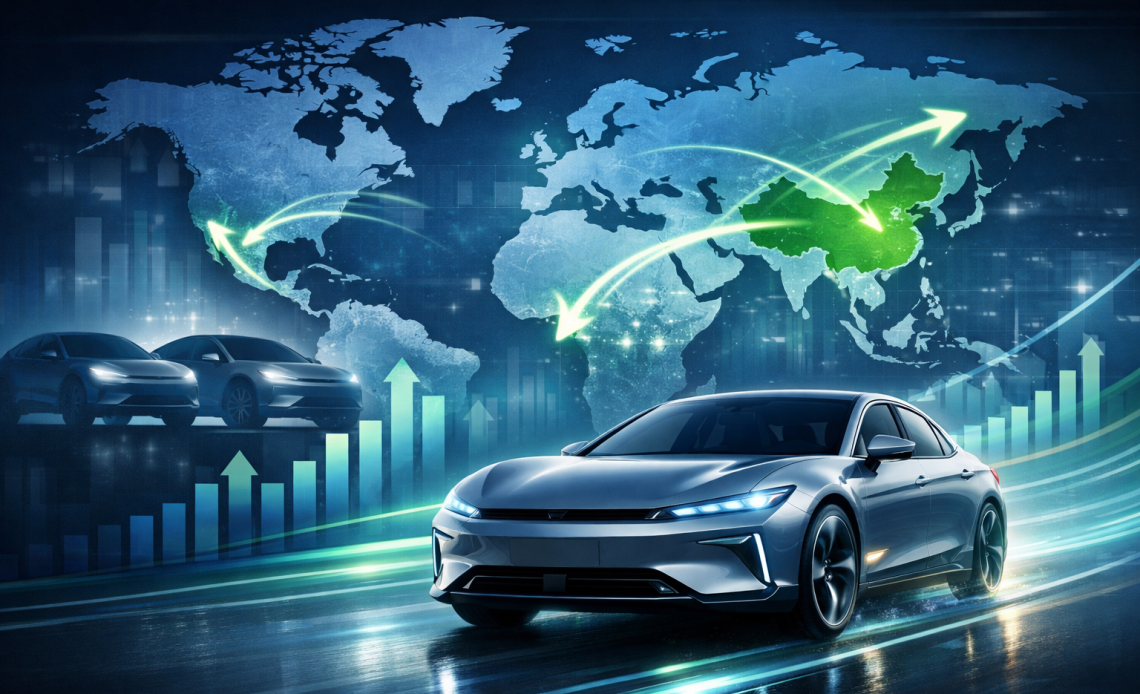
China’s electric vehicle (EV) industry is accelerating its global expansion, with exports surging across emerging and developed markets, while domestic champion BYD appears poised to overtake Tesla as the world’s largest EV seller.
The shift comes amid slowing demand for Tesla in key regions, changing subsidy regimes, and intensifying geopolitical and trade tensions around Chinese-made vehicles.
China’s EV exports surge, led by Mexico and Southeast Asia
China exported nearly 200,000 electric vehicles in November, an 87% increase year on year, according to data from China Customs.
Mexico emerged as the largest single destination, with shipments jumping 2,367% to 19,344 vehicles, highlighting the rapid penetration of Chinese EVs into Latin America.
Asia remained the biggest regional importer, taking in 110,061 EVs in November, up 71% year on year.
Europe followed with 42,927 units, a 63% increase, while Latin America and the Caribbean saw the fastest growth rate, with imports surging 283% to 35,182 vehicles.
Exports to the European Union rose 39% to 25,792 units, despite mounting trade barriers.
Among individual destinations, Indonesia, Thailand, the Philippines, Malaysia, and Turkiye all recorded sharp increases.
China exported 17,503 EVs to Indonesia and 13,517 to Thailand, while shipments to Türkiye rose 760% year on year.
Total EV exports reached about 1.98 million units year to date, up 29%.
The expansion underscores how Chinese manufacturers are diversifying geographically as competition intensifies at home and regulatory pressures grow in Western markets.
BYD set to overtake Tesla as global EV leader
Against this backdrop, BYD is on track to surpass Tesla as the world’s biggest EV company by annual sales.
By the end of November, Shenzhen-based BYD had sold 2.07 million electric vehicles globally in 2025, including hybrids, compared with Tesla’s 1.22 million units sold by the end of September.
Even accounting for a one-off sales boost Tesla received ahead of the expiration of a US tax credit for EV buyers, analysts expect the American group to fall well short.
FactSet consensus forecasts Tesla sales of about 449,000 vehicles in the fourth quarter, bringing its full-year total to roughly 1.65 million, down 7.7% from the prior year.
Deutsche Bank is even more pessimistic, projecting fourth-quarter Tesla sales of just 405,000 vehicles, with declines of around one-third in North America and Europe and about one-tenth in China.
Industry analysts say US demand is still adjusting to the end of the $7,500 federal tax credit in September, creating a transition period for the market.
BYD, meanwhile, has been pushing aggressively into overseas markets as profitability in China remains pressured by price-sensitive consumers.
Fitch Ratings said the company’s early investments in overseas production and supply chains should help it navigate an increasingly complex global tariff environment.
Tesla struggles in Europe as Chinese rivals gain ground
Tesla’s challenges are particularly visible in Europe.
New registrations of Tesla vehicles in the EU fell to 12,130 in November, down from 18,430 a year earlier, shrinking its market share from 2.1% to 1.4%, according to data from the European Automobile Manufacturers’ Association.
By contrast, Chinese manufacturers recorded strong gains.
BYD’s registrations in Europe nearly tripled year on year to about 42,500 by November, while SAIC-owned MG increased sales by 26% to 217,000 units.
Much of this growth has been driven by hybrid vehicles, which now account for 44% of European car sales, as manufacturers seek higher margins and lobby for more flexible emissions targets.
Despite these headwinds, battery electric vehicles still made up 18.8% of the European market in the first 11 months of the year, up from 15% a year earlier.
Tesla remains the only pure-play electric brand among those tracked by the industry group, even as its sales momentum weakens.
While Tesla’s automotive performance has faltered, its valuation remains elevated.
The company’s market capitalisation exceeds $1.5 trillion, more than all other Western carmakers combined, reflecting investor optimism around autonomous driving, robotics, and artificial intelligence.
Musk has said Tesla’s Cybercab robotaxi will enter production in April 2026, and analysts see advances in full self-driving technology as a potential catalyst for renewed demand.
For now, however, the balance of momentum appears to be shifting toward Chinese manufacturers, with BYD at the forefront of a rapidly evolving global EV landscape.
The post China EV exports surge as BYD set to overtake Tesla in annual sales appeared first on Invezz